9,313 votes later, Rural Communities Empowerment Center is the winner of the vote to receive the funds raised at the Star 100 New York Holiday Fundraiser! Founded in 2002, the organization has opened two community centers in Apirede and Jumapo, Ghana offering library and computer services, mentoring programs, and empowerment skills.
Thank you to everyone who voted. Now help us raise a grip for this amazing organization by attending the Star 100 Holiday Fundraiser. A portion of the proceeds from your ticket will go directly to benefit the work RCEC is doing to empower girls and women for a better future.
Buy your ticket now by clicking the "Donate" button above and submitting your payment of $50.
Happy Holiday Spirit!
DONATE $40 (EARLY BIRD RATE) FOR YOUR TICKET TO THE 2011 FUNDRAISER
Tuesday, November 29, 2011
Friday, November 25, 2011
Meet the Sponsor: Arik Air
You'll have the chance to win a free roundtrip ticket to Africa on Arik Air at the Star 100 New York Fundraiser. Click the Donate button and buy your $40 ticket now. After November 30th, tickets increase to $50.
STAR 100 NEW YORK: Who founded Arik Air and why?
ARIK AIR: In 2002, with Nigeria Airways in liquidation, Arik Air’s Chairman Sir Arumemi-Ikhide, decided to buy a Hawker jet aircraft. Colleagues and contacts in the gas and oil industry started using the Hawker jet to fly themselves around Nigeria. So, another jet was acquired and before long, a corporate jet business was launched. The next step was to find the right people and the right aircraft to build an airline that would set new standards and change the face of the aviation industry in Africa. Arik Air was born - an airline with whom “Nigeria and the rest of Africa would be proud to fly”. Arik Air officially launched in 2006, Five years later, Arik Air is the leading airline in Nigeria with a new fleet of 23 aircrafts. We have flown over 8 million satisfied passengers to all parts of Nigeria, the West African region, and internationally, winning prestigious travel awards at home and abroad.
*100: Arik has been active in sponsoring African community events and personalities. (We were particularly intrigued by your sponsorship of Fela! on Broadway and Femi Kuti's US tour!) What is the strategy behind this?
AA: Corporate Social Responsibility is one of the key principles here at Arik Air. We believe in giving back to the community that has made us the fastest growing African airline. Along with Fela! On Broadway and the Femi Kuti US Tour, we have sponsored many other US-based African NGOs, media houses, and cultural organizations who we believe are working to improve the image of Africa, and promote the variety of cultures within the continent.
*100: Air travel to West Africa can be demoralizing on certain airlines thanks to substandard service, tight weight restrictions on baggage, and exorbitant levies in the event you exceed your baggage allowance. What differentiates Arik from other airlines flying to West Africa?
AA: The great thing about an African airline for Africans is that we wholeheartedly understand the needs of our passengers and reasons for which they are traveling. For most of our passengers, traveling home is a huge endeavor that takes months, and sometimes years, of saving up to achieve. When traveling with Arik Air, you can expect a baggage weight limit of 66lbs with options to bring a total of 10 pieces of luggage, which is much higher than that of the industry standard.
Our flagship Airbus A340s are fitted out in the most luxurious style. All 36 Premier Class seats are upholstered in sumptuous leather complete with their own touch-screen control unit that adjusts the seat to a flat 75 inch bed. Features also include a five-zone lumbar massage system, a retractable mirrored divider of privacy. World class movies, popular TV programs, and audio favorites are available for each passenger’s viewing and listening pleasure on their very own 17-inch screen. Nigerian and international dishes are served with a wine list that brings together bottles selected from the best vineyards around the world. Our on board Kira Bar Lounge features white leather sofas for your relaxation and a barman at your service.
On Arik Air, even our Economy Class is World Class. With fewer seats than other leading carriers on our routes, you will enjoy more leg room to stretch out in. You will also receive the same audio and video on-demand facility available for our Premier Class passengers and a menu of Nigerian and international dishes and selected wine list.
*100: When will you start flying direct to Ghana?
AA: At Arik Air, we recognize the continuingly growing demand from other West African nationals for increased travel options to their respective countries, especially Ghana. Today we offer daily flights to Accra from our Abuja and Lagos hubs with connections available to our New York travelers through Lagos. Flying non-stop to Ghana is certainly an option that we will be exploring in the future.
STAR 100 NEW YORK: Who founded Arik Air and why?
ARIK AIR: In 2002, with Nigeria Airways in liquidation, Arik Air’s Chairman Sir Arumemi-Ikhide, decided to buy a Hawker jet aircraft. Colleagues and contacts in the gas and oil industry started using the Hawker jet to fly themselves around Nigeria. So, another jet was acquired and before long, a corporate jet business was launched. The next step was to find the right people and the right aircraft to build an airline that would set new standards and change the face of the aviation industry in Africa. Arik Air was born - an airline with whom “Nigeria and the rest of Africa would be proud to fly”. Arik Air officially launched in 2006, Five years later, Arik Air is the leading airline in Nigeria with a new fleet of 23 aircrafts. We have flown over 8 million satisfied passengers to all parts of Nigeria, the West African region, and internationally, winning prestigious travel awards at home and abroad.
*100: Arik has been active in sponsoring African community events and personalities. (We were particularly intrigued by your sponsorship of Fela! on Broadway and Femi Kuti's US tour!) What is the strategy behind this?
AA: Corporate Social Responsibility is one of the key principles here at Arik Air. We believe in giving back to the community that has made us the fastest growing African airline. Along with Fela! On Broadway and the Femi Kuti US Tour, we have sponsored many other US-based African NGOs, media houses, and cultural organizations who we believe are working to improve the image of Africa, and promote the variety of cultures within the continent.
*100: Air travel to West Africa can be demoralizing on certain airlines thanks to substandard service, tight weight restrictions on baggage, and exorbitant levies in the event you exceed your baggage allowance. What differentiates Arik from other airlines flying to West Africa?
AA: The great thing about an African airline for Africans is that we wholeheartedly understand the needs of our passengers and reasons for which they are traveling. For most of our passengers, traveling home is a huge endeavor that takes months, and sometimes years, of saving up to achieve. When traveling with Arik Air, you can expect a baggage weight limit of 66lbs with options to bring a total of 10 pieces of luggage, which is much higher than that of the industry standard.
Our flagship Airbus A340s are fitted out in the most luxurious style. All 36 Premier Class seats are upholstered in sumptuous leather complete with their own touch-screen control unit that adjusts the seat to a flat 75 inch bed. Features also include a five-zone lumbar massage system, a retractable mirrored divider of privacy. World class movies, popular TV programs, and audio favorites are available for each passenger’s viewing and listening pleasure on their very own 17-inch screen. Nigerian and international dishes are served with a wine list that brings together bottles selected from the best vineyards around the world. Our on board Kira Bar Lounge features white leather sofas for your relaxation and a barman at your service.
On Arik Air, even our Economy Class is World Class. With fewer seats than other leading carriers on our routes, you will enjoy more leg room to stretch out in. You will also receive the same audio and video on-demand facility available for our Premier Class passengers and a menu of Nigerian and international dishes and selected wine list.
*100: When will you start flying direct to Ghana?
AA: At Arik Air, we recognize the continuingly growing demand from other West African nationals for increased travel options to their respective countries, especially Ghana. Today we offer daily flights to Accra from our Abuja and Lagos hubs with connections available to our New York travelers through Lagos. Flying non-stop to Ghana is certainly an option that we will be exploring in the future.
Thursday, November 24, 2011
Meet the Sponsor: Tropical Ghana Chef Charles Cann
Chef Charles Cann is the founder of Tropical Ghana -- a contemporary approach to traditional Ghanaian cooking. You can sample his delicious bites at the Star 100 Holiday Fundraiser -- purchase your tickets today!
STAR 100 NEW YORK: What inspired you to found Tropical Ghana?
CHARLES CANN: The roots of Tropical Ghana can be traced to my days at Northwestern University. After cooking for one, two, three friends during my time at Northwestern, more and more friends kept asking me to cook. It was impossible to meet the cooking requests so I decided to put together an online Ghana cooking resource for everyone.
Later, after settling in New York City, my Northwestern friends still kept up the pressure. I got inspired to do something and dug out the forgotten online Ghana cooking resource project. After much thought, prayer, and consideration -- and also out of the desire to sustain a school supply donation drive started in 2002 to send school supplies to less privileged kids in schools in Ghana in the Ofankor/Taifa/Dome suburbs of Accra -- the Tropical Ghana Cookbooks Project was born in December 2006.
In 2010, the Tropical Ghana Cookbooks Project became Tropical Ghana – contemporary cooking, Ghana style. As part of Tropical Ghana, the Tropical Ghana Foundation aims to offer assistance to less privileged kids in Ghana to stay in school. Part of the proceeds from the sales of Tropical Ghana recipes help the foundation reach its goal of offering scholarships in small financial amounts to encourage and inspire kids to stay in school.
*100: What is "Tropical Ghanaian" cuisine?
CC: Tropical Ghana is contemporary cooking, Ghana style.
Tropical Ghana inspires, encourages, and empowers individuals who love Ghanaian cuisine, crave West African flavors, or are interested in exploring tropical ingredients, to try new recipes and share with their loved ones.
Tropical Ghana’s contemporary cooking is based on combining traditional and non-traditional techniques in cooking. Traditionally, people in Ghana cook with the goal of sharing a meal that is a balanced diet with their family and they work tirelessly to achieve this goal. Our non-traditional approach is employing creative and innovative cooking methods. Our unique contemporary approach is what makes us believe that cooking should be simple, fun and healthy.
*100: Ghanaian foods run the gamut from heavy (rich in oil) and carb-rich, to healthy (beans, fish, fresh meat, and greens including kontomre and banana leaves). What's your recommendation for a balanced Ghanaian diet?
CC: We all know a simple balanced diet should contain portions of carbohydrates (staples like yam, cassava, maize), proteins (beans, chicken, beef) and vitamins (fruits and vegetables) in right portions. In Ghana, we are blessed to have varieties of dishes that are rich in nutrients. Over the years, we have moved away from moderation and the steps to eating right. Waakye for instance is very healthy meal. The rice and beans give you proteins and carbohydrates. Should it be topped with fried plantains, tomato gravy, shito, we are on track. An orange later and we have a balanced diet.
But is that the case? Our biggest challenge is we are not moderate, we want extra plantains, macaroni, eggs, beef, wele, fish, and more gari -- by the end of the list we have killed the idea of a balanced diet. Our other challenge is that we are moving away from wholesome food and we keep adding more and more processed foods and food additives to enhance flavors which our fresh ingredients like ginger, garlic, peppers and many more offer in abundance.
Our use of oil in cooking is also excessive, and the familiar sight of a sea of oil at the top of stew, sauces, and soup is another challenge we have to fight to maintain a balanced diet and a healthier life style.
*100: Please share an easy and quick-to-prepare Tropical Ghana recipe.
CC:
Tangerine Ginger Chicken Recipe
Serves: 5
Prep Time: 15 minutes
Cooking Time: 10 minutes
1½lbs (24oz) cleaned thin sliced chicken breast
For Marinade
2 tablespoons olive oil
2 teaspoons fresh minced garlic
1 teaspoon salt
1 teaspoon cayenne pepper
For Tangerine Ginger
4 large tangerines
1 large peeled and cleaned ginger root
Time to Cook
Combine ingredients for marinade and pour over chicken in a bowl.
Cover and refrigerate for 10 minutes.
Cut ginger in pieces and combine with two juiced tangerines in a blender. Preheat grill or grilling pan.
Pour tangerine ginger mix over chicken, and coat well. Grill chicken, turning occasionally till cooked, juicy and golden brown.
Peel and slice remaining 2 tangerines, remove seeds and place over chicken.
Cut chicken into strip, stick toothpicks through tangerine slices and chicken, and serve this finger food Tropical Ghana style.
##########
The new website www.tropicalghana.com will be up in December.
STAR 100 NEW YORK: What inspired you to found Tropical Ghana?
CHARLES CANN: The roots of Tropical Ghana can be traced to my days at Northwestern University. After cooking for one, two, three friends during my time at Northwestern, more and more friends kept asking me to cook. It was impossible to meet the cooking requests so I decided to put together an online Ghana cooking resource for everyone.
Later, after settling in New York City, my Northwestern friends still kept up the pressure. I got inspired to do something and dug out the forgotten online Ghana cooking resource project. After much thought, prayer, and consideration -- and also out of the desire to sustain a school supply donation drive started in 2002 to send school supplies to less privileged kids in schools in Ghana in the Ofankor/Taifa/Dome suburbs of Accra -- the Tropical Ghana Cookbooks Project was born in December 2006.
In 2010, the Tropical Ghana Cookbooks Project became Tropical Ghana – contemporary cooking, Ghana style. As part of Tropical Ghana, the Tropical Ghana Foundation aims to offer assistance to less privileged kids in Ghana to stay in school. Part of the proceeds from the sales of Tropical Ghana recipes help the foundation reach its goal of offering scholarships in small financial amounts to encourage and inspire kids to stay in school.
*100: What is "Tropical Ghanaian" cuisine?
CC: Tropical Ghana is contemporary cooking, Ghana style.
Tropical Ghana inspires, encourages, and empowers individuals who love Ghanaian cuisine, crave West African flavors, or are interested in exploring tropical ingredients, to try new recipes and share with their loved ones.
Tropical Ghana’s contemporary cooking is based on combining traditional and non-traditional techniques in cooking. Traditionally, people in Ghana cook with the goal of sharing a meal that is a balanced diet with their family and they work tirelessly to achieve this goal. Our non-traditional approach is employing creative and innovative cooking methods. Our unique contemporary approach is what makes us believe that cooking should be simple, fun and healthy.
*100: Ghanaian foods run the gamut from heavy (rich in oil) and carb-rich, to healthy (beans, fish, fresh meat, and greens including kontomre and banana leaves). What's your recommendation for a balanced Ghanaian diet?
CC: We all know a simple balanced diet should contain portions of carbohydrates (staples like yam, cassava, maize), proteins (beans, chicken, beef) and vitamins (fruits and vegetables) in right portions. In Ghana, we are blessed to have varieties of dishes that are rich in nutrients. Over the years, we have moved away from moderation and the steps to eating right. Waakye for instance is very healthy meal. The rice and beans give you proteins and carbohydrates. Should it be topped with fried plantains, tomato gravy, shito, we are on track. An orange later and we have a balanced diet.
But is that the case? Our biggest challenge is we are not moderate, we want extra plantains, macaroni, eggs, beef, wele, fish, and more gari -- by the end of the list we have killed the idea of a balanced diet. Our other challenge is that we are moving away from wholesome food and we keep adding more and more processed foods and food additives to enhance flavors which our fresh ingredients like ginger, garlic, peppers and many more offer in abundance.
Our use of oil in cooking is also excessive, and the familiar sight of a sea of oil at the top of stew, sauces, and soup is another challenge we have to fight to maintain a balanced diet and a healthier life style.
*100: Please share an easy and quick-to-prepare Tropical Ghana recipe.
CC:
Tangerine Ginger Chicken Recipe
Serves: 5
Prep Time: 15 minutes
Cooking Time: 10 minutes
1½lbs (24oz) cleaned thin sliced chicken breast
For Marinade
2 tablespoons olive oil
2 teaspoons fresh minced garlic
1 teaspoon salt
1 teaspoon cayenne pepper
For Tangerine Ginger
4 large tangerines
1 large peeled and cleaned ginger root
Time to Cook
Combine ingredients for marinade and pour over chicken in a bowl.
Cover and refrigerate for 10 minutes.
Cut ginger in pieces and combine with two juiced tangerines in a blender. Preheat grill or grilling pan.
Pour tangerine ginger mix over chicken, and coat well. Grill chicken, turning occasionally till cooked, juicy and golden brown.
Peel and slice remaining 2 tangerines, remove seeds and place over chicken.
Cut chicken into strip, stick toothpicks through tangerine slices and chicken, and serve this finger food Tropical Ghana style.
##########
The new website www.tropicalghana.com will be up in December.
Wednesday, November 23, 2011
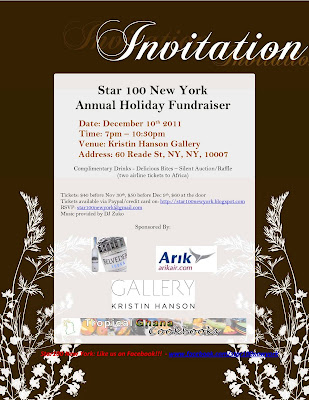
You're Invited to the Star 100 New York Holiday Party - December 10, 7-10:30p
Stars, let's have some fun and raise some FUNDS for a worthy Ghanaian charity!
On Saturday December 10th, please join us for an end of year celebration complete with delicious bites courtesy of Tropical Ghana, Afro beats provided by DJ Zuko, and drinks courtesy of Belvedere. You can also win a roundtrip ticket to Africa on Arik Air!
Buy your ticket now by clicking the "Donate" button above and submitting your secure payment of $50!
On Saturday December 10th, please join us for an end of year celebration complete with delicious bites courtesy of Tropical Ghana, Afro beats provided by DJ Zuko, and drinks courtesy of Belvedere. You can also win a roundtrip ticket to Africa on Arik Air!
Buy your ticket now by clicking the "Donate" button above and submitting your secure payment of $50!
Tuesday, November 22, 2011
Star Shots: Check Out this Ghana Photo Exhibit!
Stars, this summer several Star 100 New York members spoke on a panel at Brotherhood-SisterSol's Harlem headquarters, sharing tales of Ghana for the group of young people and their mentors, preparing to visit Ghana for the first time. On Tuesday December 6th, Brotherhood-SisterSol is exhibiting the photos from their memorable trip. Come out, come out, wherever you are and support this organization committed to empowering young people of color in New York.
RSVP: info@brotherhood-sistersol.org or 212-283-7044.
Stars, It's Time for 'New African Fashion'!
On Wednesday November 30th, Ghanaian designer Mimi Plange, legendary model and activist Bethann Hardison, Heritage1960 founder Enyinne Owunwanne, & Mataano Designers Ayaan and Idyl Mohallim are converging in the New York Public Library to fete Helen Jennings' new book and discuss its topic: New African Fashion! As editor-in-chief of one of the hottest fashion magazines on the stands dedicated to high African fashion, Jennings' book should offer more of the same commentary and eye candy. Come prepared to listen to lively discussion about Africa's impact on fashion past and present -- and to purchase a signed copy.
See you there!
Wednesday, November 30, 2011, 6 - 8p
New York Public Library
Stephen A. Schwarzman Building, Margaret Liebman Berger Forum
42nd Street and 5th Avenue
(Arrive at 5:30p to ensure a seat -- it's first come, first serve)
[photo courtesy of AFWNY.com]
See you there!
Wednesday, November 30, 2011, 6 - 8p
New York Public Library
Stephen A. Schwarzman Building, Margaret Liebman Berger Forum
42nd Street and 5th Avenue
(Arrive at 5:30p to ensure a seat -- it's first come, first serve)
[photo courtesy of AFWNY.com]
Saturday, November 12, 2011
Meet the Finalist: ORPHANAID AFRICA, FOUNDED BY LISA LOVATT-SMITH
OrphanAID Africa, founded by Lisa Lovatt-Smith, is a finalist to receive funds raised from the annual Star 100 fundraiser.
STAR 100 NEW YORK: When did you start OrphanAID Africa?
ORPHANAID AFRICA: 2002. I have been living in Ghana for ten years.
*100: What inspired you to start OrphanAID Africa?
OAA: The feeling that I, an ordinary person could change things, that it really didn't take much money to transform a child's life..that with a few dollars you can give the gift of education.. Or even the gift of life itself with proper food and care...in short, that change was possible and within my reach.
*100: What is OrphanAID's mission?
OAA: I like to summarize it in just one line:
"Helping children to grow up in stable, safe and permanent families."
But the official mission is:
Orphan Aid Africa is a non-profit, non-governmental organization. Its aim is to support orphans and vulnerable children in Ghana through programs in Care Reform, family support , education and development. Our goal is to ensure that children grow up in safe and permanent family settings with appropriate care and protection. OA is an implementing partner in the National Plan of
Action for Orphans and Vulnerable Children.
Vision
The staff and management's vision for OrphanAid Africa Ghana is:
To create an environment where orphans and vulnerable children grow up in safe, permanent and loving family settings with appropriate care and protection and with equal rights and opportunities.
To support the implementation of the NPA by migrating our family support programs to other specialized stakeholders and focusing on the areas of:
-De-institutionalization
-Tracing and reunification
-Training of parents, foster parents and social workers to support the program of tracing, reunification, and de-institutionalization work in the NPA so many OVC inappropriately placed in homes (usually for reasons of poverty) can live in family care.
*100: What have been the greatest challenges to accomplishing OrphanAID's mission?
OAA: The huge amount of money involved in child trafficking. The child trafficking
industry is powerful and completely underground so there is a mafia-like structure around it which is very frightening and has led to threats and great violence toward us and me in particular. The biggest positive has been the introduction of the national health insurance, the availability of anti-retroviral nationwide, a structured response to AIDS at the level of the
Ministry of Health, and the general ease of collaboration with government ...plus the fact
that Ghanaian society is so tolerant, moral, and caring.
*100: What has been the single most gratifying experience/victory you've had since you've been at the helm of OrphanAID?
OAA: The best experience is seeing beautiful self-confident young women and men walking around with their heads held high -- when I know that they were hours away from death when they came to us as small children.
STAR 100 NEW YORK: When did you start OrphanAID Africa?
ORPHANAID AFRICA: 2002. I have been living in Ghana for ten years.
*100: What inspired you to start OrphanAID Africa?
OAA: The feeling that I, an ordinary person could change things, that it really didn't take much money to transform a child's life..that with a few dollars you can give the gift of education.. Or even the gift of life itself with proper food and care...in short, that change was possible and within my reach.
*100: What is OrphanAID's mission?
OAA: I like to summarize it in just one line:
"Helping children to grow up in stable, safe and permanent families."
But the official mission is:
Orphan Aid Africa is a non-profit, non-governmental organization. Its aim is to support orphans and vulnerable children in Ghana through programs in Care Reform, family support , education and development. Our goal is to ensure that children grow up in safe and permanent family settings with appropriate care and protection. OA is an implementing partner in the National Plan of
Action for Orphans and Vulnerable Children.
Vision
The staff and management's vision for OrphanAid Africa Ghana is:
To create an environment where orphans and vulnerable children grow up in safe, permanent and loving family settings with appropriate care and protection and with equal rights and opportunities.
To support the implementation of the NPA by migrating our family support programs to other specialized stakeholders and focusing on the areas of:
-De-institutionalization
-Tracing and reunification
-Training of parents, foster parents and social workers to support the program of tracing, reunification, and de-institutionalization work in the NPA so many OVC inappropriately placed in homes (usually for reasons of poverty) can live in family care.
*100: What have been the greatest challenges to accomplishing OrphanAID's mission?
OAA: The huge amount of money involved in child trafficking. The child trafficking
industry is powerful and completely underground so there is a mafia-like structure around it which is very frightening and has led to threats and great violence toward us and me in particular. The biggest positive has been the introduction of the national health insurance, the availability of anti-retroviral nationwide, a structured response to AIDS at the level of the
Ministry of Health, and the general ease of collaboration with government ...plus the fact
that Ghanaian society is so tolerant, moral, and caring.
*100: What has been the single most gratifying experience/victory you've had since you've been at the helm of OrphanAID?
OAA: The best experience is seeing beautiful self-confident young women and men walking around with their heads held high -- when I know that they were hours away from death when they came to us as small children.
Subscribe to:
Comments (Atom)